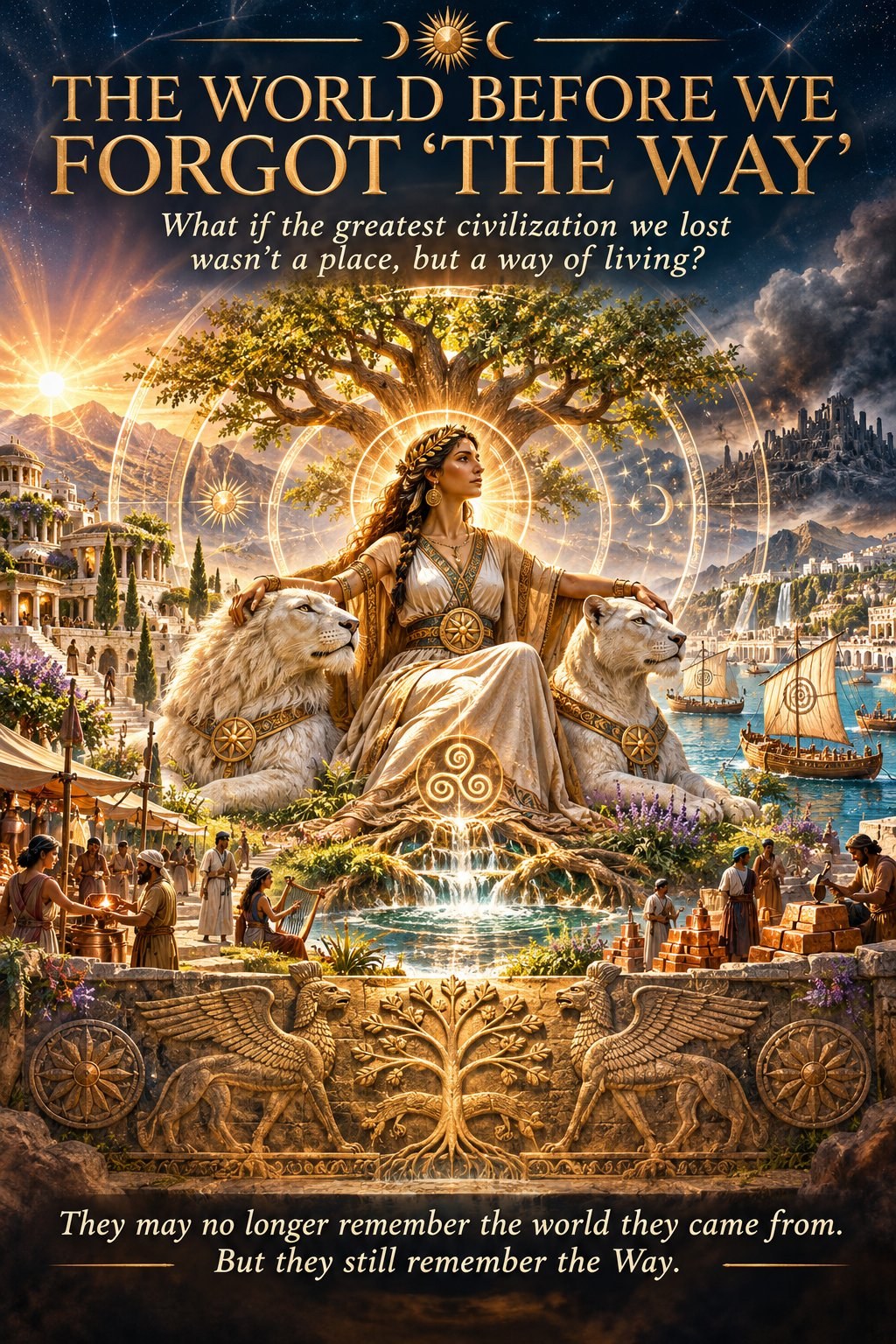
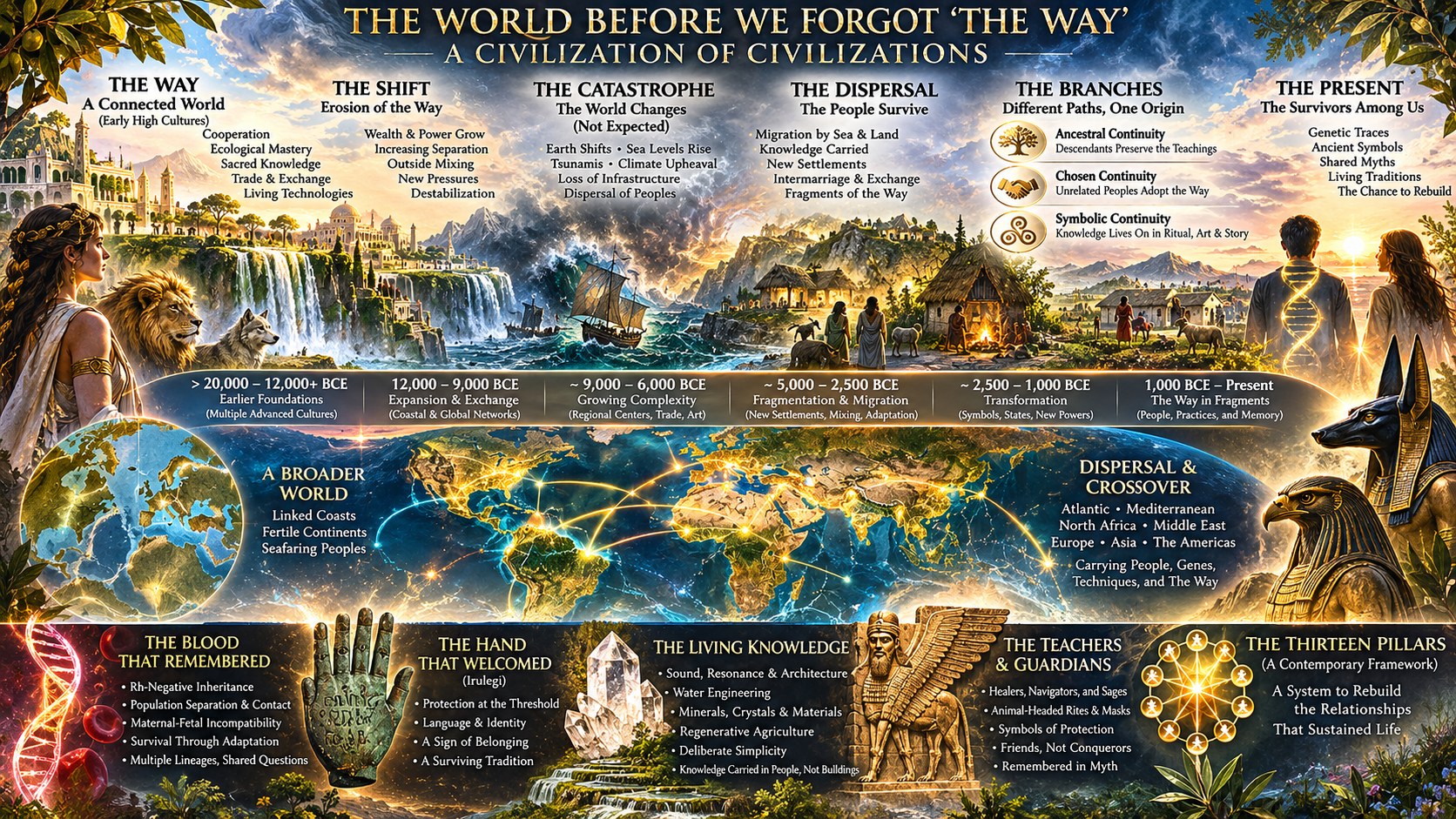
THE WORLD BEFORE WE FORGOT ‘THE WAY’
What if the greatest civilization we lost wasn't a place, but a way of living?
A Lost Civilization of People, Relationships, and Living Knowledge
THE ARK INITIATIVE | ATLANTICA CONTINUITY RESEARCH SERIES
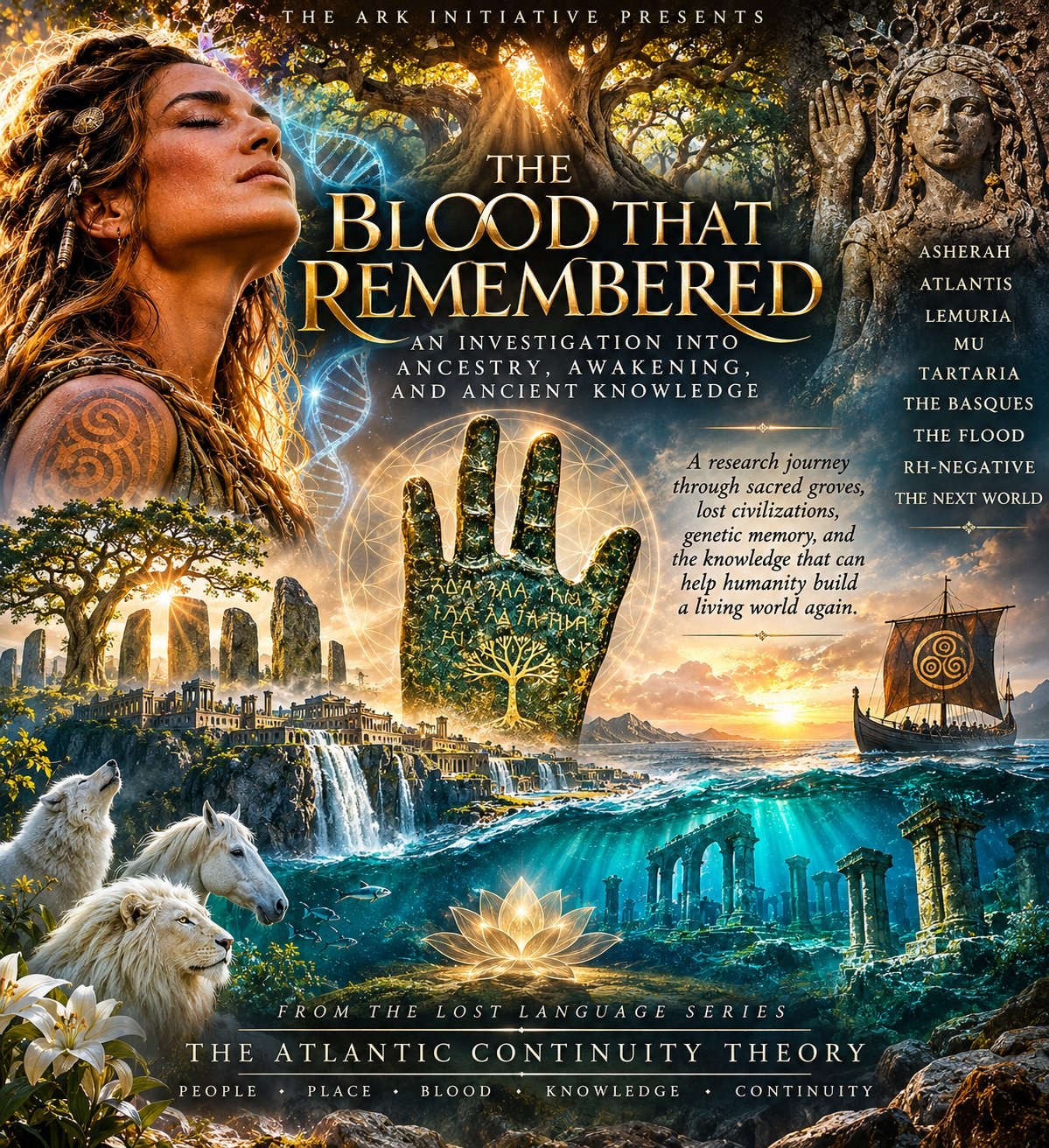
The Blood That Remembered · The Surviving Mothers · The Last Teachers · The Civilization of Civilizations
An Interdisciplinary Investigation into Ancient Civilizations, Human Ancestry, Catastrophe, Ecological Knowledge, and the Survival of Cultural Memory
November 2026
PROLOGUE — PLATO'S WARNING
What if the greatest catastrophe in human history was not the destruction of a civilization, but the loss of everything its people had learned about living together?
More than two thousand years ago, Plato left humanity an extraordinary warning.
He described a civilization of remarkable wealth, engineering, maritime power, and accumulated knowledge. Its people possessed fertile lands, magnificent structures, sophisticated infrastructure, and access to resources that other societies could scarcely imagine.
But in Critias, Plato tells us something far more interesting than the dimensions of its canals or the magnificence of its temples.
He tells us how its people once lived.
In the earliest generations, the Atlanteans were said to possess wisdom and moderation. They regarded material wealth with relative indifference. They valued their relationships with one another. Their prosperity did not yet require them to surrender their principles.
Then something changed.
Gradually, the qualities that had sustained their civilization began to diminish. Wealth became an object of desire rather than a resource to steward. Power became something to accumulate. The relationships that once held their society together began to deteriorate.
Plato describes this transformation as the weakening of their divine inheritance through its mixture with mortal nature.
That passage has usually been approached as part of his philosophical account of virtue, corruption, and political power.
But what if it also preserves a question worth asking of the wider ancient world?
What happens when a civilization develops extraordinary knowledge, but begins losing the relationships that make its knowledge life-sustaining?
And what happens to the people who refuse to abandon those relationships?
Perhaps some remain.
Perhaps some leave.
Perhaps others have already established communities beyond the original homeland, carrying its knowledge into distant landscapes.
And perhaps, when catastrophe finally comes, the civilization does not vanish entirely.
Its buildings disappear. Its institutions collapse. Its networks fracture.
But its people survive.
They survive in different places, among different populations, speaking different languages, preserving different fragments of what their ancestors once understood.
Some remember the techniques. Some remember the symbols. Some remember the stories.
And some remember something even more difficult to recover: The Way.
Historical foundation: Plato, Critias 120e–121b. The following reconstruction is an exploratory hypothesis, not a claim that Plato's account has been archaeologically verified.
ABSTRACT — THE CIVILIZATION THAT MAY HAVE SURVIVED ITS OWN DESTRUCTION
Human history is commonly reconstructed through the material remains of settlements, monuments, tools, burials, written records, and the genetic histories of populations. Yet these forms of evidence do not preserve every dimension of civilization equally.
Stone survives where wood decays. Royal inscriptions endure where household conversations disappear. Material technologies can be identified more readily than systems of trust, ecological knowledge, cooperative protection, or cultural transmission.
This paper investigates the hypothesis that ancient communities may have developed sophisticated, interconnected traditions of ecological stewardship, social cooperation, specialized knowledge, and protective organization—and that environmental catastrophe, migration, and political transformation fragmented those traditions without entirely extinguishing them.
The investigation begins with Plato's account of Atlantis and the bronze Hand of Irulegi. It follows the distribution of Rh-negative blood-group inheritance, ancient population movements, maternal-fetal immune incompatibility, prehistoric submerged coastlines, cultural dispersal, deliberately low-impact societies, and the transmission of knowledge between unrelated communities.
It then examines ancient acoustics, mineral technologies, water engineering, sacred trees, female-centered protective imagery, maritime trade, Mesopotamian sages, animal-headed ritual figures, and the transformation of protective symbols under centralized political authority.
Three proposed pathways of continuity guide the investigation:
Ancestral continuity: Knowledge and practices transmitted through descendants. Chosen continuity: Knowledge adopted by unrelated populations through friendship, teaching, exchange, and shared ways of living. Symbolic continuity: Knowledge preserved or transformed through ritual, mythology, imagery, language, and cultural memory.
The paper asks whether the disappearance of a civilization might sometimes represent not the extinction of its people, but the fragmentation of a larger system of relationships.
The ARK Initiative's thirteen-Pillar regenerative architecture provides a contemporary systems framework for exploring the implications of this hypothesis.
The central proposition is that a civilization's most consequential technology may be its understanding of how living systems remain connected without destroying their diversity.
PART ONE — THE SURVIVORS
I. THE HAND THAT REMEMBERED A message waiting two thousand years
Imagine walking through the hills of ancient Navarre.
A settlement rises above the surrounding landscape. Its people cultivate food, maintain households, work metal, and move through a world of trade, alliances, danger, and uncertain political boundaries.
You approach a dwelling. At its entrance hangs a bronze hand. It bears an inscription.
You cannot know precisely what every word means, but the object occupies a place of extraordinary significance. A threshold. The place where the safety of a household meets the uncertainty of the world outside.
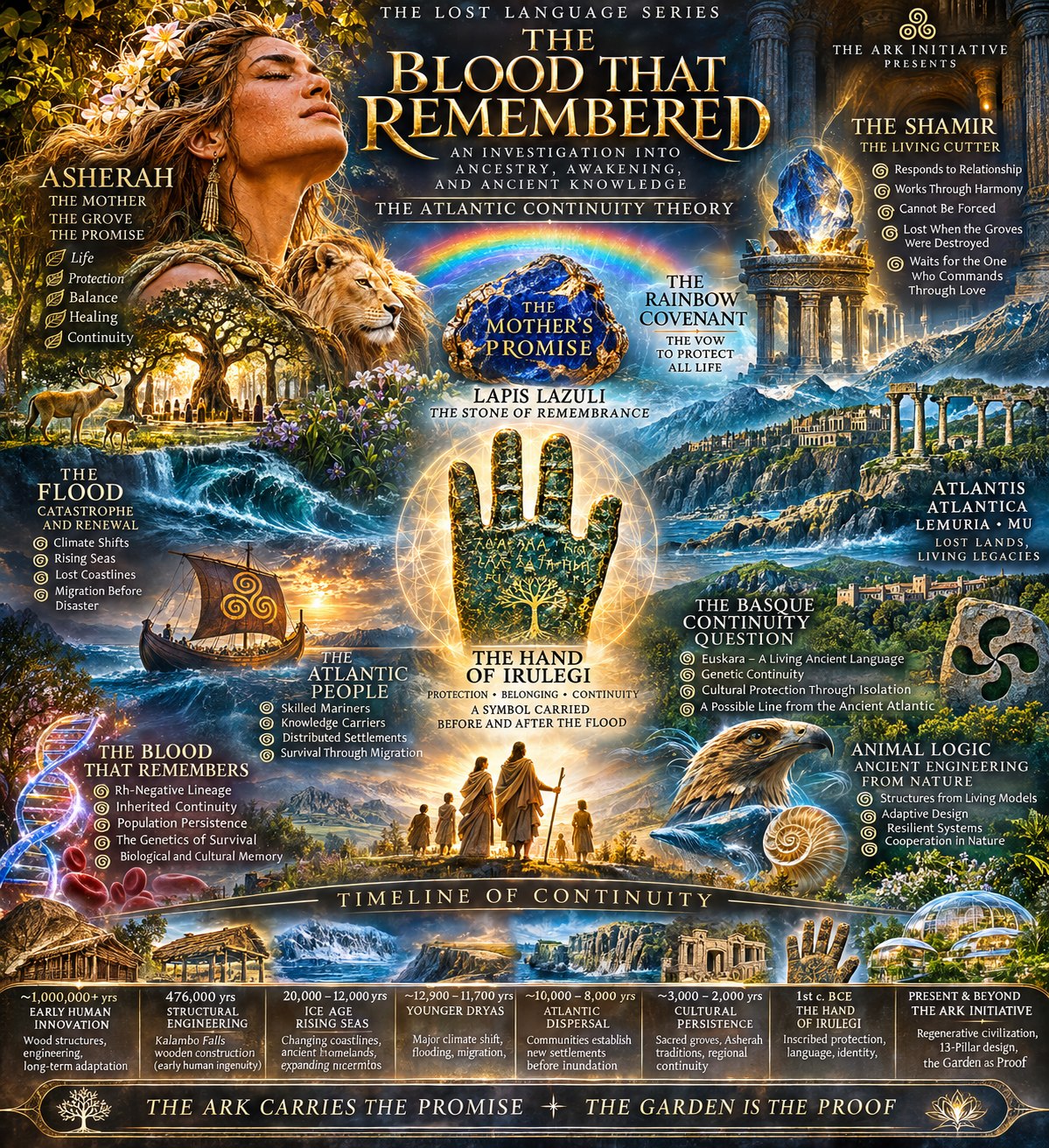
More than two thousand years later, archaeologists recover that hand from the Iron Age settlement of Irulegi, near present-day Pamplona.
The object is real. Its inscription is real. Its domestic context is real.
The opening word, sorioneku, has been compared with a Basque expression associated with good fortune, although the full inscription remains debated.
Researchers have proposed that the hand served a protective or ritual function.
And suddenly, an ancient doorway begins asking questions.
Why a hand? Why bronze? Why place language at the entrance to a home? Why should the relationship between a household and a stranger require a visible sign?
Perhaps the gesture communicated welcome. Perhaps it invoked protection. Perhaps it marked belonging, identity, or a sacred boundary.
We cannot recover the entire intention of its makers from the artifact alone.
But the hand brings together several elements that will follow us throughout this investigation.
Language. Craftsmanship. Protection. Ancestry. Boundaries.
And the possibility that an ordinary household preserved a tradition much older than the settlement itself.
What if the first clue to a vanished civilization was not a magnificent temple, but a hand extended at a doorway?
The question is not whether the Irulegi hand proves Atlantis existed. It does not.
The question is whether its combination of language, metalwork, protective symbolism, and threshold placement can help us investigate how traditions travel between generations and communities.
Because a hand can be copied. A blessing can be taught. A technique can be carried.
And a way of treating strangers can survive long after the people who first practiced it have disappeared.
Evidence anchor: Aiestaran de la Sotilla et al., Antiquity, 2024.
II. THE BLOOD THAT REMEMBERED The mothers who crossed into another world
Now imagine a different scene.
A woman stands on unfamiliar ground.
Behind her lies a homeland she may never see again.
Perhaps she fled a catastrophe. Perhaps her parents had migrated decades earlier. Perhaps her ancestors had established a distant community long before the original homeland was destroyed.
She carries a child. She also carries something invisible. An inheritance written into her blood.
The woman may have no knowledge of genetics, antigens, chromosomes, or immune sensitization.
But her body carries the biological history of countless generations.
And if she begins a family with someone from a population whose inherited blood-group characteristics differ from her own, that encounter may introduce reproductive risks she has never previously experienced.
This is where one of the most unusual questions in Atlantica Continuity begins.
The Rh-negative mystery
The Rh blood-group system is among the most clinically important inherited characteristics of human blood. Its best-known feature is the D antigen.
Individuals who possess the antigen are generally classified as RhD-positive. Those who lack it are classified as RhD-negative.
The distinction arises through genetic variation affecting the RHD gene.
But the distribution of RhD-negative inheritance is not uniform. Some European populations have comparatively high frequencies.
The Basque region has attracted particular attention because of its blood-group distribution, distinctive language, and history of relative population continuity.
Here, genetics and cultural history intersect in a fascinating way.
The Basque language, Euskara, has survived while many neighboring languages disappeared or transformed.
Genetic studies have identified important elements of continuity between present-day Basques and ancient Iberian populations.
Yet the Basques are not the only people with RhD-negative blood. Nor is RhD-negative inheritance genetically identical everywhere.
In many Europeans, RhD negativity is commonly associated with deletion of the RHD gene.
In some African populations, different RHD variants and hybrid genes can produce an RhD-negative phenotype.
This means that a familiar blood-group label may conceal several different genetic histories.
And that opens a larger investigation.
Could studying the different origins and distributions of RhD-negative variants help reconstruct ancient patterns of population separation, migration, and contact?
Not by assuming that everyone with Rh-negative blood descends from one lost civilization.
But by examining what each variant reveals about the movements and histories of actual populations.
The blood is not a map by itself. It is one layer of a much larger map.
When the body encounters an unfamiliar antigen
Now return to the mother.
An RhD-negative woman may conceive a child with an RhD-positive father.
If the fetus inherits the D antigen, the mother's immune system can sometimes become sensitized after exposure to fetal red blood cells.
The resulting antibodies may affect a later RhD-positive pregnancy.
They can cross the placenta and destroy fetal red blood cells.
Before modern preventive treatment, hemolytic disease of the fetus and newborn could cause anemia, severe illness, stillbirth, or death.
Imagine the consequences in a community already struggling with displacement.
A mother survives the loss of her homeland. She establishes a family.
Her first child may be born healthy. Then another pregnancy ends in tragedy. Another child becomes gravely ill.
The family has no way to understand the molecular mechanism. They may recognize only a frightening pattern.
The children are dying. The adults are grieving.
And the people who once understood how to preserve so many dimensions of life cannot explain what is happening inside the mother's body.
That is an emotionally powerful possibility—but it must be investigated through the actual biology.
Rh sensitization does not occur in every incompatible pregnancy. Its risk depends on inherited genotypes, prior exposure, pregnancy history, and other factors.
It also occurs between entirely ordinary members of the same human population.
There is no evidence that Rh incompatibility identifies separate human species or that it predicts violence or cultural incompatibility.
What it does establish is something important enough: Population contact can have biological consequences that are invisible until they affect the survival of children.
For a society without modern medical intervention, that could become a profound source of suffering.
And for a population already experiencing catastrophe, it might deepen the struggle to preserve continuity.
Were there other ancestral branches?
The presence of RhD-negative inheritance in different regions creates another question.
What if populations carrying different RHD variants followed different historical pathways?
Some may have remained relatively isolated. Others may have moved through established trade corridors.
Some may have experienced substantial genetic mixing. Others may have preserved distinctive local frequencies through founder effects, drift, or demographic history.
The investigation must therefore look beyond the Basques.
It must compare ancient and modern DNA across regions, including the Atlantic margins, the Mediterranean, North Africa, the Caucasus, and other areas where relevant genetic evidence exists.
The question is not whether blood type makes one people more advanced than another.
Cultural sophistication cannot be read from Rh status.
The question is whether population genetics can help identify histories of separation and reconnection that archaeology and language alone cannot fully reconstruct.
And whether those histories intersect with the movement of knowledge.
III. THE WORLD THAT DID NOT EXPECT TO END Knowledge is not the same as preparedness
Consider a civilization that has enjoyed generations of stability.
Its people understand their landscape. They know how to cultivate food, manage water, work with animals, build shelters, and maintain social relationships.
They have developed methods of teaching knowledge across generations.
Perhaps they have learned that cooperation produces more durable prosperity than constant conflict.
Perhaps their protective systems are so effective that large-scale violence has become uncommon within their communities.
Now imagine a catastrophe beyond anything their living generations have experienced.
An earthquake. A tsunami. A sequence of environmental disruptions.
The sudden loss of a critical food-producing region. The collapse of routes connecting distant communities.
Their knowledge does not vanish in the first moment.
But the conditions required to use it may disappear.
A builder may survive without the materials needed to build.
A navigator may survive without a vessel.
A healer may survive without medicines.
A teacher may survive while the students and institutions that sustained the teaching tradition are gone.
The survivors know things. They remember things. But their world has ceased to function.
This distinction matters because archaeology often reconstructs technological capacity through surviving material evidence.
A society that loses its infrastructure may appear materially simpler within a few generations.
Its descendants may retain sophisticated knowledge in forms that leave little trace.
A civilization can lose its tools before it loses its understanding.
The shock of mortality
If a population had experienced long periods of relative stability, sudden mass death might be especially destabilizing.
Its members need not have been biologically immortal or exceptionally long-lived for the experience to be devastating.
The important question is how a society accustomed to dependable relationships responds when those relationships collapse.
The loss of children. The disappearance of elders. The destruction of familiar places.
The inability to protect those who once depended upon the community.
Such experiences can transform social behavior.
People may become fearful. They may withdraw. They may become more protective of resources.
Some may begin seeking authority capable of guaranteeing safety.
Others may refuse centralized control and depart.
The same catastrophe could produce very different cultural responses.
One branch might build fortifications. Another might establish trading settlements.
Another might withdraw into forests or mountains. Another might carry its knowledge to unfamiliar people.
The civilization would not necessarily have one surviving culture. It might produce many.
PART TWO — BEFORE THE MAPS CHANGED
IV. THE WORLD BENEATH THE WATER
Imagine looking at Earth from above, but removing the political boundaries.
Now move backward through time.
The coastlines begin changing. Continental shelves emerge. Rivers extend across landscapes now covered by sea. Islands reconnect.
Regions that appear separated on modern maps become continuous land.
At the Last Glacial Maximum, global sea level was roughly 120 meters lower than today.
As the planet warmed, rising oceans transformed vast coastal environments.
The Sunda Shelf in Southeast Asia contained extensive exposed land.
Sahul joined Australia and New Guinea within a larger landmass.
The North Sea covered landscapes that had once supported terrestrial ecosystems.
Atlantic Iberian coastlines also differed substantially from their modern forms.
These changes unfolded over thousands of years, although local events could be abrupt and destructive.
The archaeological significance is enormous.
Some of the landscapes available to ancient coastal populations now lie underwater.
Settlements may have been submerged, eroded, buried, or rendered difficult to investigate.
A civilization need not have disappeared in one dramatic night for much of its coastal archaeological record to become inaccessible.
The people who left before catastrophe
The familiar story imagines survivors escaping after disaster.
But what if the most important migrations occurred before it?
Imagine generations of sailors, traders, craftspeople, and families leaving their homeland while it was still thriving.
Some establish trading stations. Others marry into distant communities.
Some create new settlements. Others deliberately choose different ways of living.
Their descendants grow up elsewhere.
Then, centuries later, environmental change destroys or obscures the original homeland.
Those distant communities do not need to escape. They are already established.
They may not even know that the place their ancestors came from has disappeared.
This model predicts a different archaeological pattern from a sudden refugee migration.
It suggests gradual cultural transmission, multiple destinations, mixed ancestry, and traditions that change as they move.
It also raises a remarkable possibility.
The people most capable of preserving a civilization may not have been those who survived its final catastrophe. They may have been those who had already left.
V. THE PEOPLE WHO CHOSE TO LEAVE ALMOST NOTHING
Imagine a group departing from a prosperous settlement.
They are not fleeing ignorance. They are not abandoning knowledge. They are making a choice.
Perhaps they reject increasing competition for wealth. Perhaps they no longer trust the emerging political authorities.
Perhaps they simply prefer a quieter relationship with the living world.
They move into a forest. They settle beside a river.
They build homes from wood, reeds, fiber, and earth.
They cultivate food and manage the surrounding ecology.
They preserve knowledge through conversation, apprenticeship, ritual, and daily practice.
They do not construct enormous monuments. They do not produce large quantities of durable goods.
They may deliberately avoid altering their landscape more than necessary.
Thousands of years later, their homes have decayed. Their fibers have vanished. Their wooden structures have disappeared.
Their settlements are difficult to detect.
An archaeologist may find stone tools, botanical remains, modified soils, or subtle traces of occupation.
But the community's full intellectual life remains largely invisible.
The mistake of measuring knowledge through monuments
Material simplicity does not establish intellectual simplicity.
A community can possess extensive knowledge of plant ecology, animal behavior, navigation, medicine, seasonal cycles, and resource management without producing monumental architecture.
The archaeological challenge is to identify indirect evidence.
Changes in vegetation. Managed landscapes. Plant residues. Food-processing techniques.
Patterns of settlement. Long-distance exchange. Repeated use of particular ecological zones.
The investigation must ask not only what people built, but what they understood.
And it must allow for a possibility often overlooked in stories of civilizational progress:
Some people may have known how to build more, yet deliberately chosen to build less.
VI. THE STRANGERS WHO BECAME FRIENDS
Now imagine a different encounter.
A small community living by a river receives visitors from another region.
The visitors are unrelated to them. They speak a different language. They possess different traditions.
Perhaps they have experienced more conflict.
Perhaps their methods of cultivation, medicine, or water management are less developed in particular areas.
But they observe how their hosts live.
They see food shared. They see children protected. They see animals treated with familiarity.
They see disputes resolved without every disagreement becoming a contest for domination.
They begin to learn.
One visitor stays. Then another. A family establishes a home.
A craftsperson teaches a technique. A healer shares knowledge.
Trade develops. Friendships form.
The newcomers are not required to surrender their identity.
They are invited to participate in a way of living.
And something extraordinary happens.
The knowledge spreads beyond the original ancestry.
The civilization that could be joined
This is the second great pathway of Atlantica Continuity.
A civilization need not be defined solely by descent. It may also be defined by participation.
People who were not born into the original communities could learn their practices, adopt their protective traditions, and become carriers of their knowledge.
Over generations, those unrelated populations might preserve aspects of the Way even after the original communities disappeared.
Some descendants of the first teachers might forget. Some adopted communities might remember.
The inheritance becomes cultural as well as biological.
And the larger civilization becomes something more interesting than an ancestral kingdom.
It becomes a network of communities joined by choice.
A civilization of civilizations.
Worlds within worlds. Different people. Different landscapes. Different customs.
But recognizable principles of protection, reciprocity, learning, and continuity.
PART THREE — THE LIVING KNOWLEDGE
VII. THE TECHNOLOGIES THAT DID NOT LOOK LIKE OURS
What would sophisticated technology look like in a civilization that regarded itself as part of the living world?
Would its greatest achievements necessarily resemble modern machines?
Or might its engineering begin with the properties of materials, the behavior of water, the movement of air, the structure of plants, and the relationships among living organisms?
Imagine builders who understand how sound travels through enclosed spaces.
Imagine craftspeople who know how different minerals respond to heat, pressure, light, and mechanical force.
Imagine water engineers who can capture, store, distribute, and cool water through carefully shaped landscapes.
Imagine agricultural specialists who understand the relationships among soil, shade, fungi, roots, insects, and seasonal change.
Such knowledge is technological even when it does not involve electricity or combustion engines.
Sound, stone, and resonance
At Chavín de Huántar in Peru, researchers have studied the acoustic properties of stone galleries and the use of conch-shell trumpets.
The site demonstrates deliberate relationships among architecture, ritual movement, and sound.
Ancient builders could manipulate acoustic experience through physical design.
That is a documented technological capability.
It invites wider investigation into ancient knowledge of resonance, vibration, and architectural acoustics.
Copper, quartz, and magnetite
Natural materials possess measurable properties.
Copper conducts heat and electricity. Quartz can exhibit piezoelectric behavior. Magnetite is magnetic.
Minerals interact with light through their structures and compositions.
Ancient craftspeople developed sophisticated knowledge of metals, stone, pigments, glass, and ceramics.
The research question is not whether these properties existed. They did.
The question is which properties ancient people recognized, how they used them, and whether surviving objects or structures preserve evidence of applications not yet fully understood.
The existence of a physical property does not demonstrate that ancient people built electrical or crystal-powered systems.
But it provides a legitimate basis for designing experiments around particular artifacts and materials.
The engineering of water
Water management provides some of the strongest evidence of sophisticated ancient environmental engineering.
Terraces. Canals. Reservoirs. Drainage networks. Irrigation systems. Water-storage structures.
These systems required observation, planning, maintenance, and the ability to coordinate people and materials.
Their effectiveness depended upon relationships among terrain, water, soil, climate, and living vegetation.
They demonstrate that sophisticated engineering can work with environmental processes rather than simply overpower them.
The technologies that survived in fragments
Ancient Roman concrete provides a revealing example.
Modern materials research has identified features of certain Roman lime-processing methods that help explain their durability and self-healing behavior.
The builders did not possess modern laboratories. They possessed accumulated practical knowledge.
Some of that knowledge was preserved in structures long after the original manufacturing traditions changed.
This raises a broader question.
How many ancient techniques were lost not because their principles were ineffective, but because the networks of teachers, materials, and institutions required to reproduce them disappeared?
VIII. THE MOTHERS WHO HELD THE CENTER
Now turn from machines and materials to the images left by ancient people.
A woman stands at the center. Animals gather around her.
Some approach peacefully. Others stand like guardians. A tree rises nearby.
The arrangement is not simply decorative. It presents relationships.
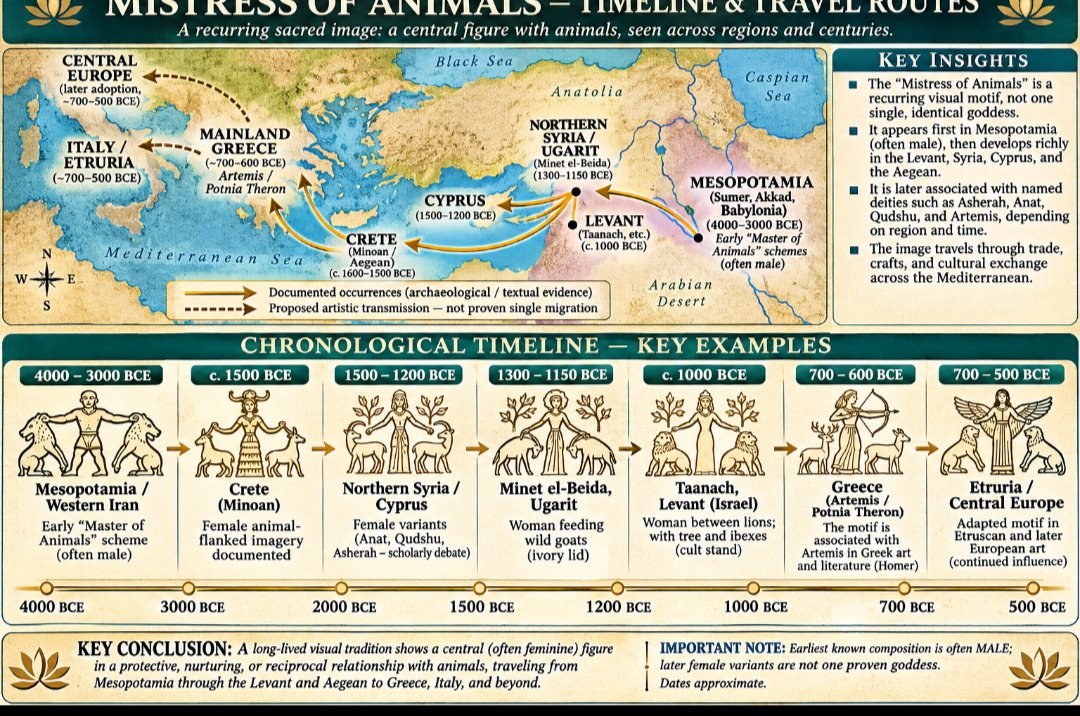
The woman who fed the wild goats
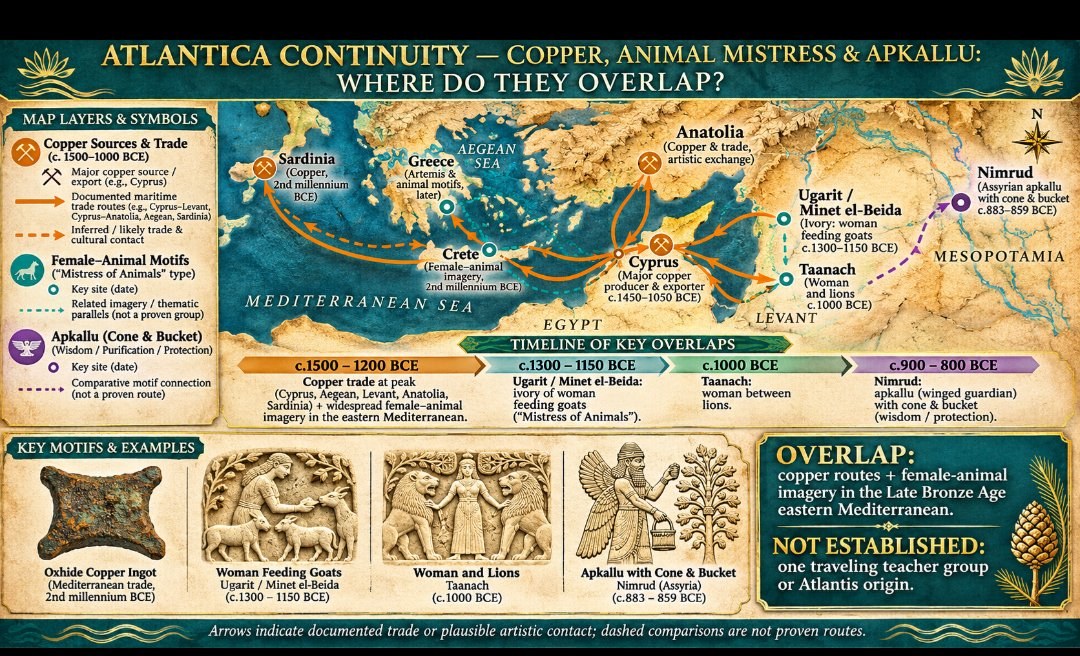
An ivory pyxis lid from Minet el-Beida, associated with ancient Ugarit, depicts a female figure feeding wild goats.
The Louvre dates the object to approximately 1300–1150 BCE.
Consider the action. The woman does not appear to be defeating the animals. She feeds them.
The animals approach. The composition places nourishment at the center of the relationship.
What did the image mean to its original viewers?
Its precise religious significance must be studied within its own culture.
But as a comparative image, it invites an extraordinary question.
What if some ancient traditions represented sacred authority through the ability to sustain life rather than dominate it?
The tree and the guardians
At Taanach, a cult stand presents a layered arrangement of female imagery, lions, vegetation, ibexes, winged beings, and celestial symbols.
The imagery belongs to a different archaeological context.
Yet its organization invites comparison.
The central figure. The surrounding animals. The protective forms. The living tree.
These elements recur in varied forms across ancient Near Eastern art.
Their meanings are not automatically identical.
But their repeated relationships offer a research pathway into how communities represented protection, abundance, sacred space, and the living world.
Asherah and the living grove
Ancient Near Eastern traditions associated with Asherah and Athirat preserve another important line of inquiry.
The historical evidence includes texts, inscriptions, sacred objects, and contested relationships with tree imagery.
The surviving record does not establish that every sacred grove was a healing center.
But groves and living trees can provide shade, food, medicinal resources, gathering spaces, and ecological stability.
They can also become places where knowledge is transmitted.
The ARK's Asherah Pillar explores this possibility as a contemporary regenerative design principle.
A living grove can be more than a symbol. It can be infrastructure.
And a civilization that understands the relationships among trees, water, soil, animals, and people may preserve knowledge in landscapes rather than monuments.
PART FOUR — THE LAST TEACHERS
IX. THE SHIP THAT CARRIED MORE THAN METAL
Around 1320 BCE, a ship sank near Uluburun, off the southern coast of present-day Türkiye.
Its cargo included approximately ten tonnes of copper and one tonne of tin, together with glass, ivory, resins, ceramics, and other materials associated with extensive exchange.
The ship reveals a world connected through specialized knowledge.
Someone mined the copper. Someone prepared the ingots. Someone understood the metallurgy.
Someone built the vessel. Someone navigated the sea. Someone organized the exchange.
The cargo represents many communities cooperating across distance.
But its most important cargo may have left no archaeological trace.
The knowledge carried by the people aboard.
Languages. Navigation. Craftsmanship. Stories. Relationships. Information about distant settlements.
The ship becomes a model for how a civilization can exist through connections rather than political unity.
And it raises another possibility. Some travelers may have been more than merchants. They may have been teachers.
X. WHEN THE TEACHERS BECAME LEGENDS
Imagine a group of travelers arriving in a community that has never encountered their techniques.
They understand how to cultivate unfamiliar crops. They recognize medicinal plants.
They can improve water management.
They possess practical knowledge that changes the lives of the people who receive them.
At first, they are strangers. Then they become trusted.
Their knowledge spreads. Their students become teachers.
Their descendants preserve stories of the people who first brought the techniques.
Generations pass.
The original visitors are no longer remembered as ordinary individuals.
They become ancestral figures. Culture heroes. Sacred teachers.
Perhaps, in some traditions, beings described through divine or supernatural imagery.
The sages before the flood
Mesopotamian literature preserves traditions of the apkallu, primordial sages associated with wisdom and the transmission of civilization.
Some traditions place these figures in the earliest ages of the world.
Their stories belong to religious and literary traditions, not straightforward biographies of historical people.
But they provide a remarkable example of how ancient communities imagined knowledge arriving from extraordinary teachers.
What if some traditions of culture-bringing figures were shaped partly by memories of real encounters with people possessing unfamiliar expertise?
The hypothesis cannot be established through resemblance alone.
It requires dated texts, archaeological context, transmission histories, and comparisons across cultures.
Yet the question is worth pursuing.
Perhaps some of the most important ancient stories concern not the arrival of rulers, but the arrival of knowledge.
XI. THE FACES OF THE TEACHERS
Now examine the figures standing beside ancient sacred trees and entrances.
Some have wings. Some possess bird-like heads.
Some wear elaborate headdresses. Some carry ritual implements.
Others appear in the forms of animals associated with particular sacred functions.
Why?
The jackal and the guardian
In ancient Egypt, Anubis was associated with embalming, funerary rites, and the protection of the dead.
Ritual specialists could wear jackal masks to embody the deity's role.
The mask did not simply conceal a face.
It transformed the appearance of the person performing a specialized sacred responsibility.
It communicated identity and function.
The bird-headed protectors
In Assyrian art, bird-headed winged figures appear beside sacred trees, entrances, and royal imagery.
They often carry a bucket and cone-shaped ritual implement.
Their imagery is associated with purification and protection.
Related protective figurines were sometimes placed beneath floors to safeguard buildings.
These are documented examples of animal forms participating in protective religious practice.
Could appearance become a language?
Imagine communities connected through trade but separated by language.
A recognizable symbol could communicate responsibility.
A particular headdress might identify a ritual specialist.
An animal emblem might represent protection.
A distinctive form of dress might signal participation in a teaching tradition.
Over generations, people could reproduce the imagery without preserving every aspect of its original meaning.
The investigation must distinguish documented ritual costumes from the hypothesis of traveling teacher-identities.
It must also ask whether descriptions of unusual physical appearance influenced how strangers were remembered.
Ancient populations varied in pigmentation and appearance, and unfamiliar visitors could have seemed striking.
But there is no established evidence that Egyptian or Assyrian animal-headed imagery originated as disguises for pale-haired or otherwise biologically distinct people.
The more promising question is functional:
Could a recognizable appearance have identified the responsibility a person carried, rather than the ancestry from which that person came?
XII. WHEN THE GUARDIANS CHANGED MASTERS
Return to the ancient images.
A woman feeds animals. A tree stands between protective figures. A hand marks a household threshold.
Now move forward into the monumental architecture of empire.
The guardians remain. The sacred tree remains. The protective arrangement remains.
But the center changes.
In Assyrian palace art, protective figures appear within the visual program of royal authority.
The imagery participates in the protection and legitimation of kingship.
This does not prove that every guardian image descended from one older peaceful tradition.
But it reveals how protective symbolism can be reorganized within different political systems.
A symbol once associated with a household may become part of state ritual.
A sacred tree may appear beside a ruler.
A protective figure may become an emblem of imperial authority.
The forms survive. Their relationships change.
And that produces one of the most important questions in the investigation.
What happens when a civilization preserves the symbols of protection but forgets that protection was meant to serve life rather than power?
PART FIVE — THE WORLD THAT FRAGMENTED
XIII. THE CATASTROPHE AFTER THE CATASTROPHE
A civilization does not always disappear when its cities fall.
Sometimes it disappears more slowly.
A harbor becomes unusable. A trade route fails. A region experiences drought.
A community loses its navigators. Another loses access to materials.
A center of learning is destroyed.
At first, the surviving network compensates.
Other communities provide resources. Teachers move. Families relocate. Knowledge continues circulating.
Then additional connections fail.
Communities become uncertain that help will arrive.
They begin protecting resources more aggressively.
Travel becomes dangerous. Knowledge becomes localized. Fear changes behavior.
The network contracts.
The catastrophe has entered a second phase.
The physical world may be recovering. But the relationships are not.
When separation becomes disconnection
There is a crucial difference between separation and disconnection.
Separation can preserve autonomy.
It allows different communities to maintain different ways of living.
Disconnection destroys the relationships that allow those communities to exchange knowledge, assistance, and protection.
The ARK's Matrix Pillar is built around this distinction.
It provides buffered separation without abandonment.
HALO protects the conditions under which contact can remain safe.
Soma maintains reserves. Delta supports circulation. Aeon preserves memory.
These are contemporary design concepts, not evidence of an identical prehistoric system.
But they offer a useful framework for asking what functions an interconnected ancient civilization would have needed to survive disruption.
Perhaps the greatest failure of a vanished world was not that its people lacked strength.
Perhaps it was that too many of the relationships supporting that strength failed at once.
XIV. THE SURVIVORS WHO DID NOT KNOW THEY WERE SURVIVORS
Imagine a child born centuries after the disappearance of an ancestral homeland.
The child has never seen the original cities.
Never walked the original coastlines.
Never heard the language as it was once spoken.
Yet the family preserves a practice.
A hand placed near a doorway. A particular way of greeting strangers.
A method of cultivating plants. A protective symbol.
A story about a great flood. A tradition concerning an ancient teacher.
The child learns these things because they are part of ordinary life.
No one calls them remnants of a lost civilization.
They are simply what the family does.
Elsewhere, another community preserves a different fragment.
A sacred tree. A healing practice. A ritual mask.
A method of managing water. A story about ancestors who arrived from across the sea.
The communities may no longer recognize one another.
They may possess different languages, appearances, and genetic histories.
Yet some of their practices may have traveled through older networks of exchange.
Others may have arisen independently in response to similar human needs.
The research challenge is to distinguish those possibilities.
Because resemblance alone is not enough.
But neither should resemblance be ignored when chronology, geography, materials, and documented contact provide reasons to investigate.
The survivors may not know they are carrying fragments of an older world.
They may simply remember how to live.
PART SIX — THE WAY
XV. THE CIVILIZATION OF CIVILIZATIONS
What if civilization was never meant to require everyone to become the same?
Imagine a world of different communities.
Some build substantial settlements. Others live in small ecological sanctuaries.
Some specialize in navigation. Others in healing.
Some cultivate crops. Others manage forests, animals, water, or materials.
They maintain different languages and customs.
They may even prefer considerable physical separation.
But they remain connected through relationships.
They exchange knowledge. They recognize protective boundaries.
They assist one another when disaster occurs.
They preserve freedom without requiring abandonment.
They maintain a shared commitment to the continuity of life.
This is the central proposition of Atlantica Continuity.
Not a single empire. Not one superior ancestry.
Not a world ruled from one magnificent capital.
But a network of communities whose strength lies in their ability to remain distinct while cooperating.
A civilization of civilizations. Worlds within worlds.
The Way as living knowledge
The phrase the Way appears in different philosophical and religious contexts.
The early Christian movement was associated with the Way.
Chinese philosophy developed the concept of the Dao.
These traditions have different histories and cannot simply be treated as descendants of one lost teaching.
But their language invites a philosophical comparison.
A way is not merely a doctrine. It is something practiced.
A way of living. A way of relating. A way of organizing power.
A way of maintaining responsibility.
For this investigation, the Way describes the practical knowledge required to sustain a civilization without destroying the relationships upon which it depends.
How to protect without dominating. How to share without extracting.
How to maintain boundaries without abandonment.
How to preserve difference without hostility.
How to carry knowledge across generations.
How to remain part of the living world while building within it.
XVI. THE THIRTEEN PILLARS — REBUILDING WHAT RELATIONSHIPS REQUIRE
The ARK Initiative's thirteen-Pillar architecture offers a contemporary systems framework for exploring these principles.
Aura Prime maintains ethical coherence. HALO provides protective symbiosis. Vagus supports nervous-system regulation. Delta maintains circulation. Asherah nurtures regenerative ecologies. Matrix preserves buffered connection, protected passage, and continuity between freely chosen paths. Aeon maintains living memory. Exchange supports reciprocity. Vega provides orientation and sensing. Ark supports adaptation and continuity. Terra provides grounding. Soma maintains reserves. Symbiosis sustains diversity and resilience.
Each Pillar contributes something distinct.
Each remains connected.
None is intended to dominate the others.
Together, they provide a framework for investigating how communities can preserve autonomy without losing the benefits of cooperation.
The historical investigation does not require proving that an ancient society possessed these exact thirteen functions in this arrangement.
Instead, it asks whether recurring patterns in archaeology, ecology, ancient symbolism, and human social organization reveal functions that successful living systems repeatedly need.
And whether those functions can be deliberately integrated into contemporary regenerative design.
CONCLUSION — THE SURVIVORS OF THE WAY
Perhaps the greatest achievement of a civilization is not the monument it leaves behind.
Perhaps it is the knowledge that continues nourishing life after the monument has fallen.
A seed preserved. A song remembered. A technique taught.
A child protected. A stranger welcomed. A community rebuilt.
A living relationship restored.
These are the threads through which human worlds endure.
The hand remains. The guardians remain. The sacred tree remains.
The ancient teachers remain in stories.
The genetic inheritance of our ancestors remains within living populations.
And across generations, people continue searching for ways to live together without destroying the world that sustains them.
Some descendants may carry ancestral memories through family traditions.
Others may preserve teachings freely adopted from people they once encountered as strangers.
Some may live in great cities. Others may choose simple lives within the natural world.
The Way does not require everyone to become the same.
It requires relationships capable of sustaining difference.
The survivors are still among us.
Generation after generation, humanity has carried fragments of earlier worlds, sometimes preserving knowledge without remembering its origins, sometimes rebuilding relationships whose deeper significance has been forgotten.
They may no longer remember the world they came from. But they still remember the Way.
RESEARCH REFERENCES AND EVIDENCE FRAMEWORK
The investigation draws on several distinct bodies of evidence. Each supports particular historical, biological, or archaeological findings; none independently establishes the complete Atlantica Continuity hypothesis.
1. Plato. Critias, 120e–121b. The account of Atlantean virtue, wealth, and moral decline. 2. Aiestaran de la Sotilla, M., et al. (2024). “A Vasconic inscription on a bronze hand: writing and rituality in the Iron Age Irulegi settlement in the Ebro Valley.” Antiquity, 98(397), 66–84. https://doi.org/10.15184/aqy.2023.199 3. Flores-Bello, A., et al. (2018). “Sequence diversity of the Rh blood group system in Basques.” European Journal of Human Genetics, 26, 1859–1866. 4. Olalde, I., et al. (2019). “The genomic history of the Iberian Peninsula over the past 8000 years.” Science, 363, 1230–1234. https://doi.org/10.1126/science.aav4040 5. National Center for Biotechnology Information. The Rh Blood Group. https://www.ncbi.nlm.nih.gov/books/NBK2269/ 6. National Center for Biotechnology Information. Hemolytic Disease of the Fetus and Newborn. https://www.ncbi.nlm.nih.gov/books/NBK557423/ 7. Lambeck, K., et al. (2014). “Sea level and global ice volumes from the Last Glacial Maximum to the Holocene.” PNAS, 111, 15296–15303. https://doi.org/10.1073/pnas.1411762111 8. Musée du Louvre. Couvercle de pyxide : maîtresse des animaux. Inventory AO 11601, Minet el-Beida. 9. Institute of Nautical Archaeology. Uluburun Late Bronze Age Shipwreck Excavation. https://nauticalarch.org/projects/uluburun-late-bronze-age-shipwreck-excavation/ 10. Seymour, L. M., et al. (2023). “Hot mixing: Mechanistic insights into the durability of ancient Roman concrete.” Science Advances, 9, eadd1602. https://doi.org/10.1126/sciadv.add1602 11. Metropolitan Museum of Art. Assyria to Iberia: Art and Culture in the Iron Age. Exhibition catalogue, 2014. 12. University of Michigan, Kelsey Museum of Archaeology. Death Dogs: The Jackal Gods of Ancient Egypt. 13. The Ark Initiative. The Blood That Remembered — Atlantic Continuity Theory. Foundational research draft, October 31, 2026. 14. The Ark Initiative. Before the Maps Changed — Integrated Research Manuscript. October 17, 2026. 15. The Ark Initiative. Before the Maps Changed — Atlantic–Basque Research Paper. October 30, 2026.
RESEARCH CLASSIFICATION
Documented evidence: Excavated artifacts, ancient texts, genetic findings, environmental measurements, and demonstrable technologies. Supported interpretation: Reconstructions grounded in multiple compatible sources. Testable hypothesis: Proposed historical connections for which additional archaeological, genetic, linguistic, or material evidence could be sought. Exploratory synthesis: The wider possibility that dispersed communities preserved fragments of an interconnected, life-centered cultural tradition.
The purpose of this framework is to permit ambitious interdisciplinary investigation without confusing a compelling historical reconstruction with an established discovery.
The Ark Initiative — Atlantica Continuity Research Series Creation only requires a little room.
Dawn Littlefield, for the Ark Initiative
#TheBloodThatRemembered #TheLostLanguage #TheArkInitiative
The Artwork of the Article
The posters, timeline, and maps created for this research, gathered below. They can also be browsed as a slideshow: Atlantica Continuity, The Research Slideshow.