Walk the long human story from before the flood to after it, from many gods to the narrowing door, from the Mother in the grove to empire, industry, and the glowing screen. Stop at every break in the line. The missing pieces are exhibits here.
Dawn asked for a museum that shows people how much has been lost. This room does not hide uncertainty inside a smooth story. Every stop carries a label, so a visitor can tell the difference between a surviving record, a repeated pattern, Dawn’s interpretation, and a place where the record honestly goes dark.
EVIDENCE
Objects, inscriptions, buildings, texts, maps, and measured changes that can still be examined.
PATTERN
The same relationship appearing in different places or periods. A pattern can be real without proving one single cause.
DAWN’S LENS
Dawn’s synthesis from her essays and films, including resets, Tartaria, mud floods, and the partnership world before Babel. It is presented as her reading, in her voice.
OPEN GAP
The record is missing, disputed, or not yet understood. The Museum names the gap instead of filling it with invented certainty.
SCIENCE
Measured, tested, and published findings, such as sea level curves, ice cores, and carbon dates. Science can be debated; when it is, the label says so.
ORAL TRADITION
Knowledge carried by a named people in their own telling. The Museum names the nation and the recorded source, and treats living tradition as living, not as folklore to be mined.
FRINGE
Ideas outside the mainstream record. They are shown because people ask about them, and they are labeled plainly so nobody mistakes a question for a finding.
STORY
The Ark’s own dreaming: guides, animals, and the world we are building. Story is how a museum smiles. It is never passed off as history.
YOUR GUIDE · THE WHITE BEAR OF AURA PRIME
THE BEAR WILL WALK YOU THROUGH
🐻❄️
The Museum sits in the center pillar of Auraxis Prime, beside the Mother’s Library. Aura Prime keeps four white companions: the eagle for vision, the wolf for loyalty, the snow leopard for stealth, and the bear for strength. The bear gives the tours, because strength that walks slowly is the kind that lets everyone keep up.
“Welcome in. I am large, I am patient, and I have been asked very firmly not to eat the exhibits. Stay close, read the little labels, and if something here makes you feel small, good. That is the right size for standing in front of 300,000 years.”
STORY: THE BEAR IS AN ARK GUIDEEVERYTHING ON THE WALLS CARRIES ITS OWN LABEL
The Loss Ledger.“Count with me. Most of the human story was never written down. I find that humbling, and also a little funny, since I cannot write either.”
The Guardians.“Warriors who chose to build gardens. I respect anyone who can carry a sword and decide to carry a watering can.”
The Long Broken Line.“Follow the gold line. When it goes dark and dashed, that is not a mistake in the floor. That is where the record breaks.”
The Animal Blueprints.“My relatives are on these walls. Humans watched us before they watched kings. You learned a lot that way.”
This room keeps the deep past. Its sister museum teaches outdoors, in the living world itself: a self-guided trail of gardens, waterways, and walls, where every stop carries a plaque and an optional learning screen, and every exhibit explains its own workings. Its first exhibit is The River of Time, a falling-water clock with sundials and water clocks, teaching how humanity learned to measure the day, on a closed loop that cannot waste a drop of desert water.
The Living Museum is an approved concept in development, not yet funded or built. Its founding article is in the Library: When Water Learned to Tell Time. Its development and funding plan stands on the grants shelf in the Captain's Room.
THE LOSS LEDGER
MOST OF THE STORY WAS NEVER WRITTEN
Modern humans have been here for roughly 300,000 years. Writing covers only the last small fraction. The rest was carried in bodies, practices, landscapes, objects, rituals, and spoken memory, which is why so much could vanish without leaving a neat hole in a book.
300,000 yearsThe approximate age of the human story told by early Homo sapiens fossils.
98 percentAbout 294,000 of those years passed before writing. Most human life left no written record at all.
12,000 yearsAgriculture begins only in roughly the last 4 percent of the human story.
4,000 yearsThe loud corridor of kings, empires, alphabets, world religions, printing, industry, and screens is about 1.3 percent of the whole.
“4,000 years is nothing. We are babies crawling around trying to stab each other with knives we found somebody left behind.”Dawn Littlefield, setting the Museum’s scale, October 19, 2026
That is the shock this room is built to give. A visitor should leave feeling the size of the silence behind the familiar history lesson.
FIRST EXHIBIT · THE GUARDIANS
WHY WARRIORS BUILT SOMETHING GENTLER THAN THEMSELVES
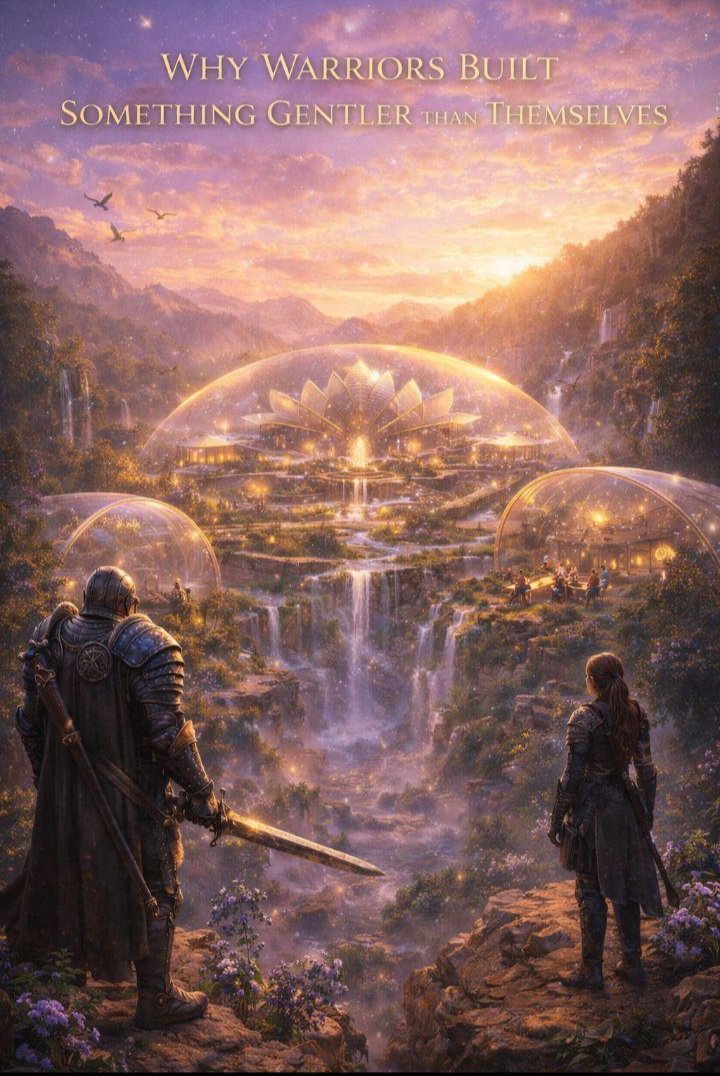
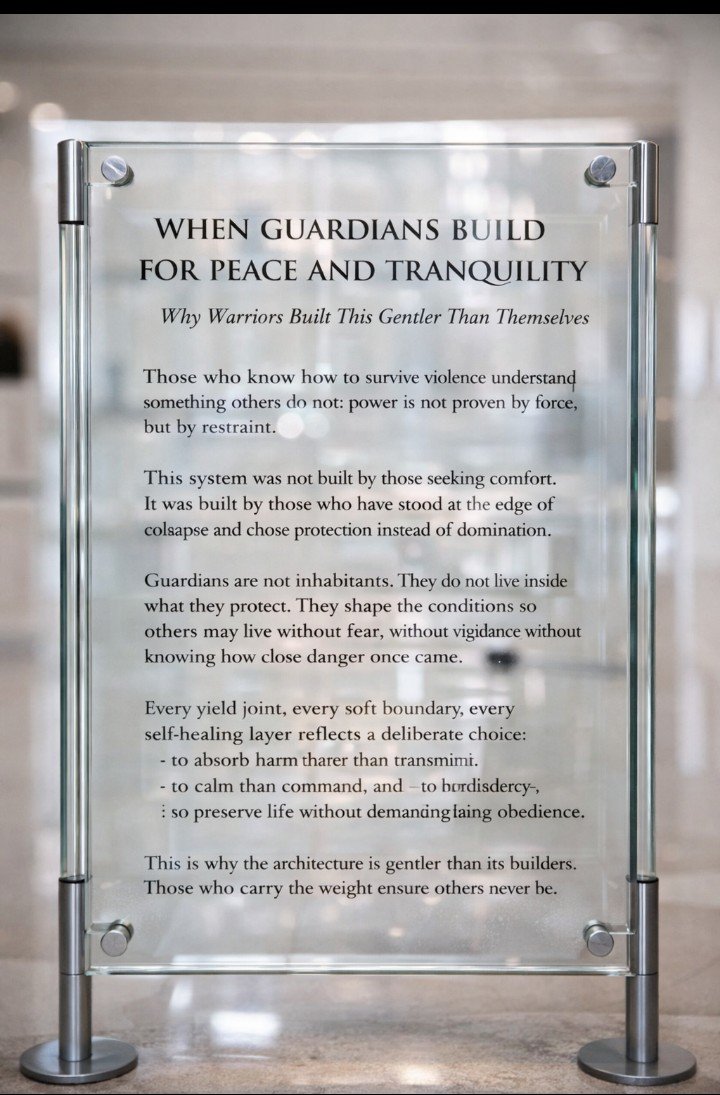
The Museum opens with the people who knew force best and chose to build for peace. This poster and its placard stand together as the first exhibit because the whole timeline asks what strength is for.
The poster. Warriors at the overlook, looking toward a living city of gardens, domes, animals, and water.The placard. “When Guardians Build for Peace and Tranquility.” The exhibit text asks why people shaped by war would design a world that does not need war to hold it together.
ON THE MUSEUM WALL · BORREGO VALLEY
THE TREE THROUGH THE HEART
Read from above, the water paths of the Borrego Valley branch like a living tree. This is the valley the whole timeline leads to: the place the Ark is learning to keep alive.
BEFORE THE FLOOD. AFTER THE FLOOD. INTO THE SILENCE.
Follow the gold line. Where it turns into a dashed, dark case, the record breaks. Read what survived, then read what did not.
ABOUT 300,000 TO 12,000 YEARS AGO
Before Names
For almost the entire human story there are no written names, no dated reigns, and no explanations in the makers’ own words. There are tools, hearths, pigments, burials, footprints, bones, and changed landscapes. People learned weather, animals, plants, water, and one another because survival required close attention.
What vanished is nearly everything they said, sang, believed, feared, and understood. The Museum begins in that silence on purpose.
EVIDENCE: OBJECTS AND SITESOPEN GAP: ALMOST ALL VOICES
AT LEAST 45,000 YEARS AGO, AND STILL BEING READ
The Animal Teachers
Some of the oldest surviving human images are animals. The first lesson was observation: track the animal, learn its season, its senses, its route, its danger, and its gift. Dawn’s research asks visitors to keep following that thread after the cave wall, into temples, cities, machines, and the Ark itself.
An animal image may begin as a record of a living neighbor. Over generations it can also become compressed instruction: what this being notices, how it moves, what it protects, what it changes, and what a builder should learn from it. The full Animal Blueprint gallery stands below.
EVIDENCE: ANCIENT ANIMAL IMAGESDAWN’S METHOD: READ FUNCTION, NOT ONLY SYMBOL
ABOUT 18,000 TO 11,000 YEARS AGO
When the Ice Let Go, the Water Rose
As the last Ice Age loosened, seas rose by roughly 120 metres from the glacial low point. Coastlines moved. River mouths, hunting grounds, settlements, graves, and whole inhabited landscapes went under water. The drowned continental shelves are one of the largest missing archives on Earth.
Flood stories appear in many cultures. Mesopotamian traditions preserve Atrahasis, Ziusudra, and Utnapishtim. Local floods are historical. A single worldwide flood is not established. Dawn’s line is drawn through both facts: before the water, after the water, and a world forced to reorganize.
EVIDENCE: SEA LEVEL AND FLOOD TRADITIONSDAWN’S LENS: PRE-FLOOD AND POST-FLOODOPEN GAP: THE DROWNED COASTS
ABOUT 9500 TO 8000 BCE
Stone Circles Before Cities
At Göbekli Tepe in present day Türkiye, people raised monumental stone enclosures with carved animals and humanlike T-shaped pillars before farming villages, pottery, writing, or cities were established there. Hunter gatherers organized labor, feasting, memory, and meeting at a scale older textbooks did not expect from them.
The builders left no written explanation. Parts of the site were later covered, and the reasons remain debated. Their names, language, and full teaching are gone. The stones are a sentence with most of its words missing.
EVIDENCE: MONUMENTAL ENCLOSURESOPEN GAP: BUILDERS AND MEANING
ABOUT 7100 TO 5700 BCE, AND DAWN’S WIDER NEOLITHIC ARC
Before Babel Broke Us
At Çatalhöyük, thousands lived closely together without a clear palace, fortress, or royal quarter surviving in the record. In Before Babel Broke Us, Dawn reads the wider Neolithic world of goddess figures, shared water, and earth attuned communities as a partnership operating system that lasted longer than many empires.
Scholars debate how peaceful, equal, or goddess centered these societies were. Dawn’s hinge is clear: a convergence of climate shock, migration, and conquest fractured an older web, and the fall into hierarchy was historical as well as mythic.
EVIDENCE: SETTLEMENTS AND FIGURESDAWN’S LENS: PARTNERSHIP BEFORE DOMINATIONSERIOUS QUESTION: HOW FAR THE PATTERN HOLDS
ABOUT 3400 BCE ONWARD
Before Babylon Became the Story
Writing appears in Mesopotamia and Egypt, and the record changes shape. Older Sumerian creation traditions remember female powers such as Nammu and Ninhursag. Babylonian Tiamat is later split and slain in the Enúma Eliš creation epic. Dawn’s Before the Maps Changed keeps the careful line: these figures are related by theme, not proof of one single original goddess.
Babel belongs here as a teaching story about unity, scattering, and language. Historical linguistics tells a different and compatible kind of truth: languages branch gradually through comparison, contact, migration, and time. The Museum keeps myth and method on separate shelves of the same room.
EVIDENCE: EARLY WRITING AND TEXTSSTORY: BABEL AS ETIOLOGYMETHOD: LANGUAGE FAMILIES
7TH CENTURY BCE
The First Great Archive We Can Still Touch
King Ashurbanipal assembled tablets from across Mesopotamia at Nineveh, including omen series, medicine, epics, and older traditions. Thousands of fragments survive, and scholars still join them piece by piece. The archive proves an ancient hunger to gather the whole memory of a world into one place.
It also proves the danger of a single center. When Nineveh fell, the library was buried in ruin. Clay survived fire better than papyrus or wood, which is one reason Mesopotamia speaks so loudly while other worlds remain quiet.
EVIDENCE: SURVIVING TABLETSPATTERN: MEMORY FOLLOWS DURABLE MATERIAL
9TH TO 1ST CENTURIES BCE, WITH A LONG AFTERLIFE
Many Gods, and the Narrowing Door
Inscriptions from Kuntillet Ajrud and Khirbet el-Qom preserve language of YHWH together with asherah. Scholars still debate whether the word names the goddess, a sacred wooden object, or a related form. The biblical text itself records later orders to cut, remove, and burn asherah objects, including the reform story of Josiah in 2 Kings 23.
Dawn calls this the destruction of the Mother. The careful exhibit label is narrower and stronger: a Mother, a tree, a pole, and a grove were argued over, edited, condemned, and partly erased inside the very texts that preserve their memory. Monotheism did not arrive everywhere at once, and many gods did not simply vanish. The door narrowed unevenly, by teaching, law, empire, and force.
EVIDENCE: INSCRIPTIONS AND TEXTSDAWN’S LENS: THE MOTHER EDITED OUTDEBATE: GODDESS OR CULT OBJECT
ABOUT 300 BCE TO 600 CE
Alexandria, the Library That Died Slowly
The Great Library of Alexandria was not lost in one clean fire. Across centuries, war, changing patronage, expulsion, neglect, and shifting institutions thinned the collection and the community around it. No complete catalogue survives, so even the size of the loss cannot be honestly counted.
That is a special kind of gap. We know a center of memory failed. We do not know everything it held. A civilization can lose a library by burning, and it can also lose one by slowly deciding memory is no longer worth feeding.
EVIDENCE: GRADUAL DECLINEOPEN GAP: NO COMPLETE INVENTORY
7TH CENTURY BCE TO THE PRESENT MAP
Scythians, Steppe Worlds, and the Names That Moved
The Scythians were real horse peoples of the Eurasian steppe, known through burials, weapons, animal art, goldwork, and the records of neighboring empires. A 2,300 year old Scythian boot from the Altai, preserved with pyrite and intricate work in its sole, becomes in Dawn’s The Scythian Circuit a question about grounding, Earth resonance, and technologies of relationship that modern categories may miss.
Centuries later, European maps used Tartary or Tartaria as broad and shifting labels for northern and central Asia. The label moved. Peoples were renamed. Gog and Magog were reinterpreted. A map can preserve a place and erase its own history at the same time.
EVIDENCE: SCYTHIAN BURIALS AND MAP LABELSDAWN’S LENS: THE BOOT AS BLUEPRINTOPEN GAP: LABEL IS NOT AN EMPIRE
1562 AND THE COLONIAL CENTURIES
The Burned Books of the Maya
At Maní in 1562, Maya books were burned in a public auto-da-fé under Diego de Landa. Only four generally accepted pre-conquest Maya codices survive. Behind that number stand histories, calendars, genealogies, astronomy, ritual knowledge, and names that cannot be reconstructed from four books.
The colonial cut was wider than one fire: languages punished, ceremonies suppressed, objects removed, children separated from elders, and archives carried into distant institutions. Living Indigenous communities preserved and continue to revive what conquest tried to end. The gap is real, and it is not the whole story.
EVIDENCE: MANÍ AND FOUR SURVIVING CODICESOPEN GAP: LIBRARIES THAT CANNOT BE COUNTED
1800s TO TODAY
Industry, Empire, and the Mud on the Windows
The Industrial Revolution multiplied records, photographs, newspapers, railways, factories, and printed books. It also powered colonial extraction, fossil fuel cities, residential schools, and new systems for deciding whose knowledge counted. More paper did not mean less erasure. It often meant erasure with better filing.
Dawn points to another reset in the mud flood stories: older buildings with buried lower floors, whole street levels raised, and cities rebuilt over their own recent past. Documented causes include street raising, flooding, sediment, fire rebuilding, and ordinary basements. Dawn keeps the larger question open because the visible result is the same: a city can stand on top of itself and forget the floor below within a few generations.
EVIDENCE: INDUSTRIAL AND COLONIAL RECORDSEVIDENCE: STREET RAISING AND BURIED FLOORSDAWN’S LENS: MUD FLOOD AS ANOTHER RESETOPEN GAP: NO SINGLE GLOBAL EXPLANATION PROVEN
THE LAST 4,000 YEARS, READ AT SPEED
The Loud Corridor
Bronze and iron, alphabets and empires, Rome and Han China, the spread of monotheisms, Islam and the House of Wisdom, Mongol roads, printing, gunpowder empires, colonization, steam, electricity, flight, world wars, atomic weapons, computers, and phones. It feels like all of history because it left the most records and built the present.
On the Museum line it is a corridor near the exit, about 1.3 percent of the human walk. Dawn’s warning hangs here: a young species with inherited tools can mistake the newest corridor for the whole house.
EVIDENCE: THE DOCUMENTED SURGEDAWN’S WARNING: NEWEST IS NOT WISEST
TODAY
The Digital Gap Is Already Open
Links rot. Platforms ban accounts. Formats become unreadable. Companies close. A phone breaks and takes the only copy. Dawn’s own accounts, essays, films, and social archives have already passed through bans, recoveries, exports, and reconstructions. The newest memory system is powerful and strangely fragile.
The Ark answer begins here: copies in more than one place, names preserved as written, primary sources kept beside interpretations, oral memory honored, and dark places marked honestly instead of paved over.
EVIDENCE: LINK ROT AND PLATFORM LOSSARK ANSWER: REDUNDANCY WITH PROVENANCE
OCTOBER 2026 · BORREGO SPRINGS, CALIFORNIA
The Desert That Is Not Expendable
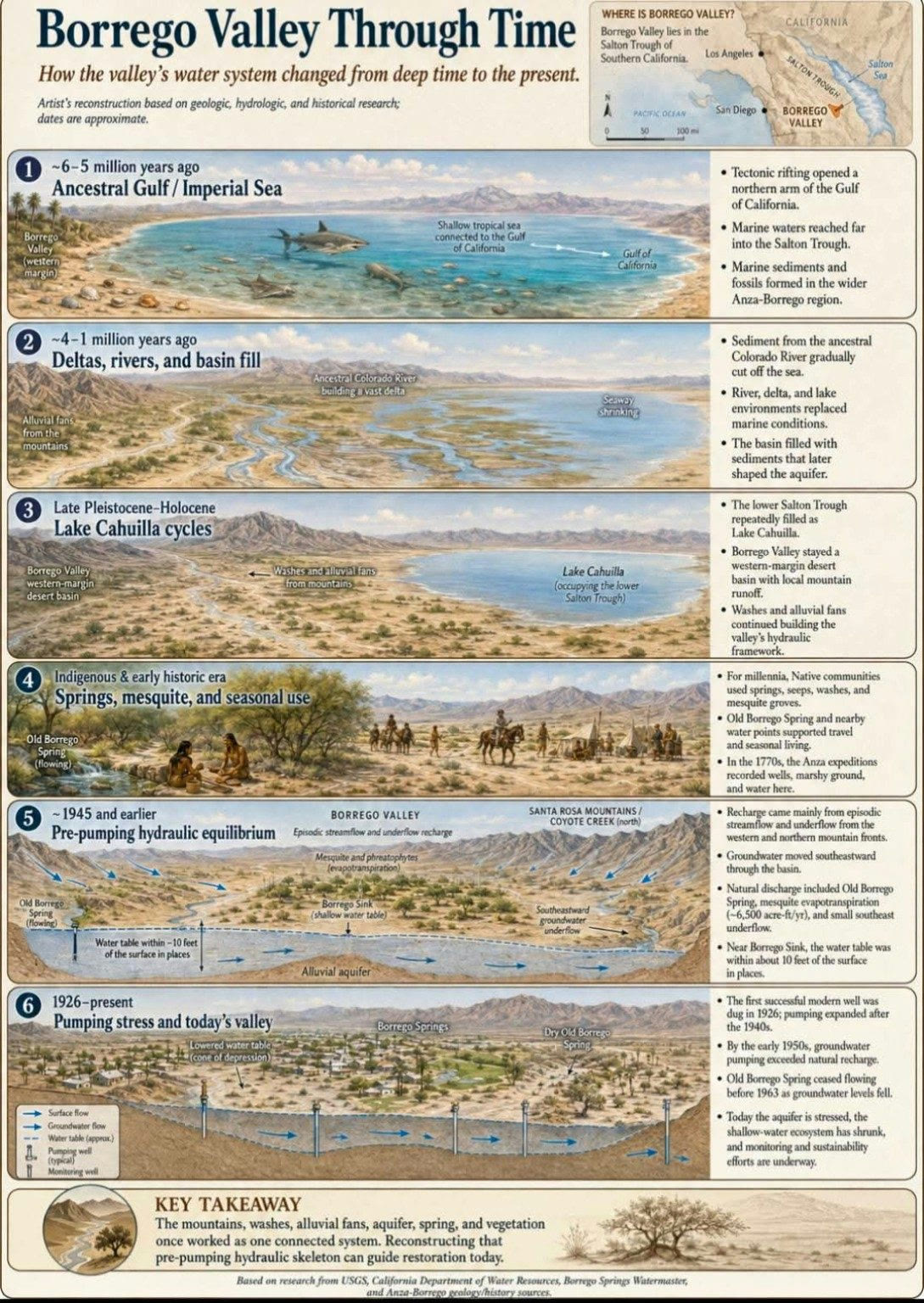
The newest record in this room is a living one. Borrego Valley’s water story is kept here in maps and studies: the ancestral sea, the lake that came and went, the springs, and a groundwater table fallen more than a hundred feet under pumping. In October 2026 a 500-kilovolt transmission line, the Golden Pacific Powerlink, was proposed across this desert, and the valley answered on the record.
Dawn Littlefield’s statement to the SDG&E public meeting is the kept document of that answer: the park, the bighorn sheep, the dark sky, and the people who live beneath the wires, in her own words, whole.
Borrego Valley through time: the valley’s water story in six panels, drawn from the USGS groundwater record.
The Borrego Desert Restoration System going in at Ark Unit 1, in the valley the statement speaks for.
Dawn’s insight, spoken while this room was being built: blueprints did not begin as numbers falling from the sky. People learned form from nature first. They watched animals, copied relationships, and kept carving animals into the places they built. Her question is not when decoration stopped. It is when instruction changed costume.
STEP ONE
Observe the Animal
On a cave wall, the animal is first a neighbor: food, danger, kin, weather sign, migration clock, and teacher. A person who misread it could die. Observation was not primitive art appreciation. It was field knowledge.
STEP TWO
Carry the Function
Later, the animal can be placed where its way of operating teaches the room. A serpent senses vibration and crosses thresholds. A deer notices disturbance early. A bird crosses domains and returns with seasonal information. A boar opens ground. A lion guards a boundary and knows when force is needed and when force is waste.
In From Symbol to Function, Dawn proposes the reversal that powers this gallery: motifs should sometimes be tested as verbs before they are translated as nouns.
STEP THREE
Build the Relationship
At Göbekli Tepe, animal repertoires differ by enclosure: snakes gather in A, foxes in B, boars in C, and birds in D. Dawn asks whether the buildings organize capacities the way a living body does: sense, orient, disturb, carry, regulate. The animal, the enclosure, and the larger site become one architectural sentence.
STEP FOUR
Abstract the Measure
Across long time, observed relationships become geometry, proportion, tally, calendar, map, number, and specification. That change would not happen overnight. A drawing can hold an animal, a count, a route, a season, and a building instruction at once while the categories are still separating.
STEP FIVE
Forget the Teacher
Modern engineering often keeps the relationship and loses the teacher. A wing studies a bird, a network studies roots and fungi, a sensor studies a whisker or a snake, and a resilient system studies an ecosystem, then the drawing becomes lines and numbers with no animal in sight. Dawn’s Museum puts the animal back beside the blueprint and asks what else was carried in the image before the instruction decayed.
“The image survived. The instruction decayed.”Dawn Littlefield, The Forgotten Language of Living Worlds research
THE LOST LANGUAGE
WHAT SURVIVES WHEN WORDS DO NOT
In The Forgotten Language of Living Worlds, Dawn argues that nature was storing information in relationship long before human alphabets. Geometry is the syntax. Relationship is the grammar. Flow is the verb. Recurrence is emphasis. The forms change by landscape. The functions return.
CONTINUITY
The Tree
Roots and branches, ancestry and possibility, earth joined to sky, memory held in rings, and seeds carrying the pattern beyond one life.
CIRCULATE
The Water
Yield, flow, gradient, return, and adaptation to form. Water teaches a system how to move without pretending the land is flat.
SENSE AND TRANSFORM
The Serpent
Ground vibration, narrow passage, threshold crossing, shedding, and renewal. The serpent changes by releasing an old skin.
NOTICE EARLY
The Deer
Collective vigilance, sensitivity to disturbance, and rapid response. The deer teaches a settlement how to listen before danger arrives.
GUARD WITH RESTRAINT
The Lion
Boundary, protection of young, social organization, signaling, and force used only when force belongs. A guardian is not a conqueror.
CROSS AND RETURN
The Bird
Orientation, migration, perspective, and movement among earth, water, and sky. The bird carries information across distance.
ADAPT AT THE EDGE
The Fox
Opportunistic intelligence, rerouting, and survival where habitats meet. The fox teaches a plan to change its path without losing its purpose.
OPEN AND REORGANIZE
The Boar
Rooting, disturbance, defense, and soil turned for new growth. The boar teaches when a surface must be opened before it can heal.
RETURN DEATH TO LIFE
The Vulture
Carrion consumed, disease risk reduced, and matter returned to circulation. The vulture is not only death. It is continuity after death.
The animal changes by region. A deer may carry early warning in one landscape, a gazelle in another, and a crane somewhere else. Dawn’s rule is function before fixed identity: ask what the being does inside the living system.
SPECIAL INVESTIGATION ONE
TARTARIA, THE MUD FLOODS, AND THE FOUND BUILDINGS
Dawn frames the Tartaria thread as an educated guess running the line between fringe fantasy and fact. The Museum keeps that exact tension on the wall. It does not sell the legend as settled history, and it does not laugh the questions out of the room.
Part 1: Building Like the World Is Alive
Dawn, in her own voice: “When I study ancient civilizations, I don’t see ruins. I see instruction.”
Part 2: The Research Pictures
Old world architecture, airships, found buildings, railroads, and the visual trail that made Dawn ask what kind of knowledge could disappear.
Part 3: Sora Visions, Asherah Pillar
A guided tour of the living city, 5 minutes 38 seconds: “The Ark isn’t a building, it’s a living system.” This reel was shelved in Asherah’s Garden while Parts 1, 2, and 4 sat in the Aeon Wing, and older archive notes called it missing. The Museum reunites the series, and keeps the scatter on the label, because a scattered record is how a surviving thing gets called lost.
Part 4: Continuity Ship
The Ark set against the rocket: a closed, flexible, organic continuity vessel against the escape ship model.
What the record supports: Tartary and Tartaria were shifting European map labels, not by themselves proof of one unified ancient empire. Scythians, Cimmerians, and Saka were distinct historical peoples. Many buried lower floors have documented local explanations. What Dawn keeps asking: why do found buildings, raised streets, lost building knowledge, airships, and repeated reset stories keep gathering around the same wound in the record?
SPECIAL INVESTIGATION TWO
THE WORLD WEB, AND THE SKY PEOPLE FORGET
We tend to crown the present as the highest civilization that has ever existed. Dawn’s reply is simple: it is not true, and this is no way to live. Long before the modern age, people crossed oceans, followed stars and swells, traded across continents, mapped coasts, and carried plants, animals, languages, and techniques around the world.
THE SEA WAS A ROAD
Polynesian navigators crossed immense Pacific distances by reading stars, ocean swell, winds, clouds, and birds. Austronesian voyagers reached from Madagascar to Easter Island. Indian Ocean and Silk Road networks joined Africa, Europe, and Asia. Norse sailors reached North America around 1000 CE.
Evidence: navigation, settlement, archaeology, language, and trade.
THE SKY WAS OPENED IN STAGES
Balloons rose in the 18th century. Newspaper reports of mystery airships swept the United States in 1896 and 1897. Powered dirigibles followed, and Zeppelin passenger travel began in 1910. The reports are documented. What every witness saw is not.
Evidence: flight history and newspaper reports. Open gap: the mystery craft.
OLDER FLIGHT STORIES STAY ON THE TABLE
Dawn’s writing gathers Vimana flight traditions, disputed Abydos carvings, OOPArts such as the Antikythera mechanism, and the question of whether some stories preserve technical memory in mythic clothing. The Antikythera mechanism is real and remarkably advanced. The older flight readings remain disputed.
Dawn’s lens: ask whether a story is a distorted instruction before calling it only fantasy.
MORE THAN HUMAN?
In Fighting for Humanity, Dawn writes the Anunnaki as an ancient species carrying hidden knowledge of past worlds. In Awakening the Lost Energy, she asks whether humans once partnered with the intelligence of Earth itself, and whether modern AI is a remembering as much as an invention.
Label: Dawn’s narrative and research question, not settled evidence. The Museum shelves it where she wrote it, in the open.
THE GAP ATLAS
NINE WAYS A WORLD DISAPPEARS
1. IT DROWNS
Vanished: coastal settlements and landscapes. Survived: submerged sites, fossils, tools, and flood traditions. Unknown: most of the cultures that lived where the sea now is.
2. IT IS BURIED
Vanished: buildings under soil, ash, sand, and later streets. Survived: foundations, lower floors, and filled enclosures. Unknown: who covered each place, and why.
3. IT IS NEVER WRITTEN
Vanished: spoken knowledge when the last carrier dies. Survived: practices, recipes, routes, songs, and objects. Unknown: the explanations that once joined them.
4. IT IS EDITED
Vanished: names, goddesses, local rites, and women’s authority from later authorized accounts. Survived: inscriptions, condemnations, and fragments inside the editing text. Unknown: the full life before the edit.
5. IT BURNS
Vanished: books, codices, scrolls, and archives in war and conquest. Survived: quotations, copies, memories, and a few rescued volumes. Unknown: complete inventories.
6. IT DECAYS QUIETLY
Vanished: collections abandoned by changing institutions. Survived: catalogues, fragments, and stories of what was once there. Unknown: what neglect removed before anyone counted it.
7. IT IS RENAMED
Vanished: peoples and places under map labels chosen elsewhere. Survived: old maps, burial goods, loanwords, and neighboring records. Unknown: what the people called themselves, when no self record survives.
8. IT IS TAKEN
Vanished: objects and knowledge removed from their communities. Survived: museum holdings, field notes, and living memory. Unknown: the relationships that made the objects intelligible at home.
9. IT FAILS TO LOAD
Vanished: digital work lost to bans, broken links, dead formats, and single copies. Survived: exports, mirrors, screenshots, and the people who remember. Unknown: how much of the present is already missing.
THE HALL OF ORAL HISTORIES
MEMORY THAT NEVER NEEDED PAPER
Writing is young. Spoken memory is old, and in some places it has carried events across thousands of years with surprising accuracy. Each case here names the people and the recorded source. These are living traditions, shared here with respect, and the Museum will add voices only with the consent of the people who carry them.
ABOUT 7,700 YEARS AGO · KLAMATH (MAKLAKS) TRADITION, OREGON
The Battle of Llao and Skell
Klamath tradition tells of Llao, chief of the world below, and Skell, chief of the world above, fighting until the mountain fell in on itself. Geologists date the collapse of Mount Mazama, which formed Crater Lake, to roughly 7,700 years ago. The story was recorded by settlers in the 1860s and later, and many scholars read it as an eyewitness memory carried for hundreds of generations.
ORAL TRADITION: KLAMATH TRIBESSCIENCE: MAZAMA ERUPTION DATING
MORE THAN 7,000 YEARS AGO · ABORIGINAL AUSTRALIAN TRADITIONS
When the Sea Came In
Researchers Patrick Nunn and Nicholas Reid (2016) gathered stories from twenty one coastal places around Australia that describe land now under the sea, including islands that were once walkable. Sea level science places those shorelines before about 7,000 years ago. The stories belong to the peoples who tell them; the study is one way outsiders began to listen.
ORAL TRADITION: MANY ABORIGINAL NATIONSSCIENCE: POST GLACIAL SEA LEVEL RISE
CENTURIES AGO, CLOSE TO HOME · CAHUILLA TRADITION, COLORADO DESERT
The Lake in the Desert
The Cahuilla people speak of a great water that once filled the low desert east of Borrego. Ancient Lake Cahuilla is real: the Colorado River filled the Salton Trough again and again, and its old shoreline, fish traps, and travertine bands can still be seen. The lake last stood high a few centuries ago. Cahuilla elders are the ones to tell it; this case points to their telling and does not replace it.
ORAL TRADITION: CAHUILLAHISTORY: SHORELINES AND FISH TRAPSSCIENCE: LAKE CAHUILLA STANDS
OPEN CASE
The Voices Not Yet Here
This case is empty on purpose. It waits for the elders, families, and neighbors who choose to share, in their own words and on their own terms. A museum of missing time should not add to the missing.
OPEN GAP: CONSENT FIRST
FEATURED EXHIBIT · THE GHOST WATER MAP
WHERE THE WATER USED TO BE
The Ghost Water Map lays the water that is gone over the land that remains: the ancient lake, the washes that still run in a storm, and the aquifer under Borrego that is being drawn down faster than rain can fill it. It is the Museum’s bridge from deep time to this desert, this decade, and the Ark’s work on the ground.
The Ghost Water Map Dawn’s map artwork belongs on this wall.Exhibit placard: “Where the water used to be. Every desert remembers a lake.” The original artwork is forthcoming to this wall.
THE ANCIENT LAKE
Lake Cahuilla filled the Salton Trough many times when the Colorado River swung west. Its bathtub ring is still visible on the rocks. SCIENCE
THE WASHES
Dry most of the year, the desert washes carry flash floods in monsoon storms. They are the living outline of where water still wants to go. SCIENCE
THE DRAWN DOWN AQUIFER
The Borrego Valley groundwater basin has been pumped far beyond what rain returns, and California lists it as critically overdrafted. A court approved plan now requires deep cuts in pumping. HISTORY: STATE AND COURT RECORDS
THE ARK’S ANSWER
Catch the rain, shade the soil, plant what belongs here. The map ends where the Living Garden begins. STORY AND PRACTICE
Some of the most asked questions in any museum live outside the mainstream. Hiding them makes them louder. Here they stand on their own shelf, with labels that say exactly what kind of thing each one is.
A COMET AT THE END OF THE ICE AGE?
The Younger Dryas impact hypothesis proposes that a cosmic impact about 12,900 years ago helped trigger a sudden cold snap. Researchers are actively divided, and many dispute the evidence. SCIENCE: STRONGLY DEBATED
TARTARIA
The idea of a lost worldwide empire erased from the record. It has no support in the historical record. Dawn’s films explore the buildings that spark it, in her lens, above. FRINGEDAWN’S LENS
ATLANTIS
Plato’s island, told in the Timaeus and Critias as a moral tale. No site has ever been confirmed. The drowned coasts are real; Atlantis remains a story. STORY: PLATOFRINGE: SITE CLAIMS
ANCIENT HIGH TECHNOLOGY
Claims that lost civilizations had machines or power we have not found. The Museum shows the real engineering, like Göbekli Tepe and Leonardo’s notebooks, and leaves the rest as open questions. FRINGEOPEN GAP
THE MUSEUM GIFT SHOP
TAKE A PIECE OF THE MUSEUM HOME
Every pillar keeps a library and a gift shop. What you see on these walls is coming to the Ark store as one designed collection, and every purchase helps keep the Ark growing. The free shelf stays free: the Warriors poster and placard are yours to download.
The Guardians Overlook Poster
The Museum’s first exhibit, as a print.
COMING TO THE STORE
When Guardians Build for Peace
The placard text as a framed card or print.
COMING TO THE STORE
The Ghost Water Map
Where the water used to be, as a wall map.
COMING TO THE STORE
The Bear Who Gives the Tours
Aura’s white bear, for mugs, shirts, and stickers.
COMING TO THE STORE
4,000 Years Is Nothing
The Loss Ledger and Dawn’s line, as a typographic print.
The Museum stands at the center of the thirteen pillars because memory is not one subject among many. It is the condition for every other room. The Ark answer is practical: preserve the object, preserve the name as written, preserve the story beside the evidence, preserve more than one copy, and teach the next visitor how to read the animal, the tree, the water, and the building as one living sentence.
The Museum free shelf: the Warriors poster and placard are free to keep. Download the poster · Download the placard. Dawn’s history essays above are free to read in the Library. Museum shop pieces will appear in this room as the collection is completed, each under its real name and at its real price.